lunes, 31 de marzo de 2014

1º ESO: JUMPING EVENTS

watch this movie and answer these questions:
a) How high is the high jump  world record?
b) What is the most difficult part of high jump? Why?

https://www.youtube.com/watch?v=XBtBdNHBNSI                                    

   JUMPING EVENTS

 In order to be a good long or high jumper you need speed, strength, and mental endurance. The object of jumping is to run down a long runway and then jump into a sand pit or a big mat. After jumping your distance is measured from the furthest back point in the sand where you landed in long jump. You know the height of the bar before jumping in high jump.  Whoever jumps the furthest and highest wins.

Rules of Long Jump and High Jump
There are three basics rules.
1. If you plant your foot on the opposite side of the white line before jumping you will receive no score. The same happens if you touch the bar during the flight of high jump. This is called a foul.
2. Your jump will be measured from the furthest back point. For example, if you jump 3,50 cm but your hand goes back 20 cm you will be given a 3,30 foot mark.
3. The person that jumps the furthest or highest wins the competition!
Long and high jump is a very focused sport. You must be focused because there is a lot to think about. You must think about steps, speed (running), height, distance or height, and landing. The better you get used to these things the less you will have to think about. Practice and practice is the only thing that will help you learn how to jump further and higher. “Practice makes perfect”

JUMPING STAGES
B.1.- Stepping and running
Long jump
You must have the perfect steps before you jump. Finding the right steps is quite easy. Count however many steps you would like to take in the speed running before the jump . Seven or nine strides with your dominant foot is usually a good number to start with. When you know it, run as fast as you can!!!
Speed is very important to gain distance when you jump. To gain speed you have to run with high knees and use your arms.

High jump

An An aggressive sprint approaching the bar is the key to a good high jump. The run-in should be curved in towards the bar to give your body the angle and speed to launch.


 agg the s the key to a good jump.p
B.2-Height
Long jump
The longer  you stay in the air the further you go. Therefore, it is important to gain lots of height so you will not fall as quickly to the ground (sand pit). On take-off, power yourself by driving your leading leg upward.


 High jump
You should take off from the foot furthest from the bar. This will be the right foot if you come in from the left. Use your arms to power yourself over the bar.


B.3.-Flight
Long jump
It is important to help force your body through the air by circling your arms. They should first go downward, then backward, upward and finally forward. To delay landing too early, thrust both legs outward in their extended position, and drive your hands down. This will throw your shoulders and head forward.


High jump
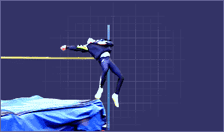
Use your leading leg to twist your body over the bar and aim to lay back. These three things will help you the clear the bar:
1.- Arms to your side.
2.- Arch your back
3.- Lift your hips


B.4.- Landing
Long jump
Landing is a very important part of long jump. If you have the perfect jump but land wrong you have just ruined the whole jump. You should land steady and with your feet as close as they can be together. If you jump with your legs straight out you should land on your bottom. Your jump is measured from the furthest back point so you do not want to put your hand back when you jump. Landing is not complicated, if you get it right it is quite simple.
On landing, bend your knees and move your upper body forward as you hit the sand.
To get a longer jump and prevent yourself from falling backwards, lean to one side as you land, using one elbow for balance. If you land on sand, the sand slides forward and you can touch with your bottom on the sand. However, if you land in a mat, don´t try it. You must only land with your feet at the same time as far as you can.
After landing, remember walking back through the sand pit will get you disqualified in a competition.


High Jump
Even after your bottom has cleared the bar, make sure you lift your head and feet to complete the clearance. Jumping too high too early and overarching your back are common mistakes which lead to knocking the bar off.


viernes, 28 de febrero de 2014

4º ESO: BADMINTON

Badminton 4º ESO
 History of Badminton
The roots of badminton can be traced back thousands of years, although the origin is unknown. Games involving a racket and a shuttlecock were probably developed and played in Ancient Greece.
The inception of badminton in England starts with the popular pastime of 'Battledore and Shuttlecock'. This involved using a paddle to keep a shuttlecock off the ground for as long as possible.

New Badminton Scoring System

The scoring system for badminton has changed in recent years. This was done to speed games up and make them more entertaining to watch. A badminton game is now played up to 21 points, and a point can be scored from every rally, even if you are serving. Under the old system a point could only be scored by the player holding the serve. If the score reaches 20-20 then a two-point advantage is required for victory. If no player has managed to achieve this two-point advantage by the time the score reaches 29-29, then the first player to reach 30 is the winner. Matches are generally played over the best-of-three sets.

Serving

The rules regarding the serve in badminton are very particular. Here are the key points to remember:
Singles
  • At the beginning of the game (0-0) and when the servers score is even, the server serves from the right service court. When the server's score is odd, the server serves from the left service court.
  • If the server wins a rally, the server scores a point and then serves again from the alternate service court.
  • If the receiver wins a rally, the receiver scores a point and becomes the new server. They serve from the appropriate service court; left if their score is odd, and right if it is even.
Doubles
  • Each pair only has one serve.
  • At the beginning of the game and when the score is even, the server serves from the right service court. When it is odd, the server serves from the left court.
  • If the serving side wins a rally, the serving side scores a point and the same server serves again from the alternate service court.


BADMINTON SHOTS


  DROP SHOT
It  shall land in your opponent's frontcourt area, as close to the net as possible. The point of impact is above the racket shoulder. It is intended to move your opponent to the frontcourt, hopefully forcing a weak return to your midcourt for you to kill.


SMASH
The smash is a shot hit with power and speed downward to your opponent's court. The angle and the steepness of the shuttle's trajectory will make it hard for your opponent to retrieve.

Contact the shuttle further in front of your body than the clear or the drop shot. The optimum hitting zone is located somewhere above the central area of your racket.


You can also jump and smash the shuttle at the same time to generate more power and create a steeper angle for the shot. This will give your opponent even lesser time to react. As this is a more advance shot, master the normal badminton smash first before taking on any jumping smash.
BADMINTON DRIVE
Badminton Drive shots are shots that crosses the net flatly in a horizontal trajectory. It can be played both on the forehand and backhand sides.
The drive is an attacking shot that is usually played from the sides of the court when the shuttle has fallen too low for it to be returned with a smash. The shuttle shall be between your shoulder and knee height.
Badminton drive shot can be played diagonally crosscourt or straight down the line.
BADMINTON CLEARS
Badminton Clears are the most common and important of all badminton strokes that can be played overhead or underarm. These shots can be played both on the forehand and backhand sides.
Attacking clear or LOB  has a trajectory that runs almost parallel to the ground. The shuttle travels flat and fast towards your opponents back court. These badminton shots allow less time to your opponent to get behind the shuttle, potentially causing weak returns. The shuttle is hit square with your racket face.


Defensive Clear has a high and deep trajectory. These badminton shots give you more time to return to your base and prepare for the next shot. The shuttle is hit with your racket face leaning slightly backwards.


Underarm Clear


The underarm clear is usually played from the front court area to your opponent's back court. Whether to play it high and deep or a flatter, cross court clear will depend on the situation at that time and your opponent's positioning on court.

In any case, try to reach the shuttle as early as possible so that you can have various shot options. Your wrist action is the crucial element in creating a deception for your shots.

 Underarm clear.

 Extend and put your racket up when you go for the shot.
- The point of impact shall be well out in front of you and as high as possible with your racket leg leading in a lunge position.


Practice hard on your Badminton Clears and your game will benefit tremendously...

Badminton - Top Tips!
Badminton is a very tactical and strategic game. Basically you need to keep returning the shuttle for longer than the opponent whilst t, and move them around the court using a variety of shots, with disguise if possible. Being a quick thinker is important to make decisions about what shot to play, in the limited time players have to return the shuttle effectively.
For beginners to badminton the main points to focus on are:
  • Hitting the shuttle consistently high and deep to give time to recover. (go to the middle of your court quickly)
  • Keep the basic position always.
  • Try to aim shots to the opponents weaker side (usually backhand), to give the advantage off a weak return.
  • Try to place shots before adding more power, because more power will usually result in more errors.
  • Try to keep the opponent on the move as much as possible.
  •  Try moving the opponent from the net to the back and from the forehand to backhand side to fatigue them quicker.
  • Keep winning, keep playing the same way
  • Keep losing change the style of play
  • Try to change the speed of play, by mixing up shots. For example hit some slower shots, such as, drop shots and net shots, with faster shots in between, such as, smashes, and drives.
Vocabulary:
Rally: peloteo o punto   shuttle/ shuttlecock: volante   roots: origenes 

regarding: concierne, respecta