martes, 27 de mayo de 2014

HOW TO MAKE A DANCE ROUTINE. 4º ESO


1.- Pick a song. The song all depends on what type of dance you're preforming. Make sure you can move along to the beat just fine and know you can create moves to. If you're a ballet dancer, pick soft, slow music, as to being a hip hop dancer, you'll probably need very fast paced pop music.

2.-Find out who you're dancing with if you are dancing with anyone. You'll need to coordinate dance moves with them, whether it's a duet or a group dance. Make sure you plan rehearsal time for you and your partner.

3.- Once you agree on the perfect song, divide the lyrics to the song into small groups of words. If the song has no lyrics, 10-20 second parts will work.

4.-Think of some dance moves you can do and make them fit the lyrics and beat. Start by breaking up the lyrics into sets of four to eight lines, depending on the tempo of the song. Assign a few "moves" for each set. Make sure to end each set with a move that the next set of moves can easily flow from. Don't make your dance match exactly with the words (for example for "fire", don't act like fire).
When it comes to the chorus or the refrain, attempt at making the moves a bit more complicated. Since a song normally repeats two or three times, it's best to create more impressive moves for this part. It'll wow the audience. Do similar moves for each chorus but not the same moves. Although if you do repeat it the audience will like it but not as much.

5.-Create dance moves to go with each of the musical segments that you have created. Try to make it so that the moves go with the beat of the music and/or express the lyrics.

6.- If you are dancing with a group of friends or are teaching a class, be sure that everyone knows the moves to one part before moving on.

7.- Practice! The saying practice makes perfect isn't exactly true. In dance, it's more like practice makes better, and eventually better makes perfect. Make sure everyone knows each part and has it down, knows the movement on each part. Schedule different times to practice and make sure you know it and it looks good before you show it.
8.- Get other people's opinions. Show your parents and friends and have them comment and critique you.

9.- When you are performing your finished routine, find a way to coordinate your outfits (e.g. wearing red t-shirts and black pants). 10.- 
Make sure when you perform, you have a huge smile on your face. Enjoy the feeling of everyone watching you, and also enjoy the feeling of doing what you love.

martes, 29 de abril de 2014

4º ESO: TRAINING PRINCIPLES AND FITNESS PLAN

WHY DO PEOPLE GET INVOLVED IN PHYSICAL ACTIVITY?

People get involved in exercise for a number of reasons: to improve their health and physical condition, to achieve a sporting ambition, to relieve the tension and stress of daily life, to lose weight, it makes them feel good. Participating in any  collective sport (soccer, basketball…) is a good way to improve physical condition, develops the element of competitiveness, provides a physical challenge and the opportunity to meet new people and make new friends. Find your way to get fit.

PRINCIPLES OF TRAINING

Training to improve an athlete's performance obeys the main principles of training: specificity, overload, recovery, adaptation, continuity and reversibility.

1.- SPECIFICITY

To improve the range of movement for a particular joint action, you have to perform exercises that involve that joint action. It is quite possible for an athlete to have good mobility in the shoulder joint but to have poor hip mobility. Conducting shoulder mobility exercises may further improve the shoulder mobility but it will not affect hip mobility.
The coach (this year you are your own coach) can analyze the technique of his/her event, identify which joint actions are involved and determine which components of physical fitness (stamina, strength, suppleness, speed) are involved in your sport or you need for your physical condition target.
Ask yourself if you need to train aerobic or anaerobic stamina and which type of strength is required in your activity.

2.- OVERLOAD

When you are training you should choose between the different parameters involved in intensity and volume in order to further adaptive responses as training develops, and the training stimulus is gradually raised. The parameters you will manage in this training program will be: time, repetitions, sets,  heart-rate and weight or load in strength,
 The load must be progressively increased. Overload can be progressed by:
  • increasing the resistance  adding, fro example, 5kg to the barbell
  • increasing the number of repetitions with a particular weight
  • increasing the number of sets of the exercise (work)
  • increasing the intensity- more work in the same time, i.e. reducing the recovery periods
  • increasing time in stamina training.
  • Increasing heart-rate (130-160) continuous training. You can start with the lower heart-rate and increase bit a bit.
Remember: you know better than anyone you physical condition level. Choose the right load for your level. Overtraining is as incorrect as not training.
How many days a week?

 If you are training for a competition: 5-6 days a week.

 If you want to lose weight, get fit and so on: 3-4 days a week.

Training methods.
After the first term, you should know which training methods you are going to choose according to your targets and your level.

3.- RECOVERY

Rest is required so that the body recovers from the training and to allow adaptation to take place.

4.- ADAPTATION AND CONTINUITY.

The body will react to the training loads imposed by increasing its ability to cope with those loads. Adaptation occurs during the recovery period after the training session is completed.
The most noticeable effect of weight training is larger and stronger muscles (hypertrophy).
The rate of adaptation will depend on the volume, intensity and frequency of the exercise sessions.
Continuity: you need many weeks or months to achieve the adaptations.

5.- REVERSIBILITY OR DETRAINING

When training ceases the training effect will also stop. The researchers recommend that training programs should limit periods of complete inactivity to no more than two to three weeks. Prolonged periods of inactivity should be avoided and the training programme should incorporate some form of "maintenance" training.


INDIVIDUAL FITNESS PLAN

OBJECTIVE:
  Make a fitness plan, personal training, respecting the basic principles of sports training.  The individual needs of each one are the guide of this plan.

CONTENTS:

1.-COVER PAGE (Name, Surname, group).

2.- DETAILED EXPLANATION OF PERSONAL GOALS FOR THIS WORK PLAN:
A) General fitness: Explain your current physical condition speaking about your BMI and the level you have in every physical condition you did at the beggining of the current year. Explain your Goals: General Fitness (ideal weight maintenance or weight loss, toning up, improved body image and appearance, improvements in all basic physical skills).
B) Improved athletic performance in sport practiced (explaining that sport and the needs of endurance, strength, speed and suppleness in this sport).
 Explain your current physical condition speaking about your BMI and the level you have in every physical condition you did at the beggining of the current year.

3 .- WEEKLY PROGRESSION (6 weeks) of the training routine in volume, frequency and intensity of work. Use Excel or Word table.  You should indicate:


a) The method of training used in each work session (theory of the first term).

b) Characteristics in volume and intensity:

Stamina (working time and beats per minute). 

Strength (load percentage, repetitions and sets). 

Suppleness (method,  number of stretching exercises and time for exercise).

4 .- Design drawings and explanations of strength circuit and stretching activity.
FORMAT:
Attach all the work to an email  to the following address:

trabajosdeefeduardo@gmail.com

Email Subject: NAME, SURNAME. GROUP. INDIVIDUAL FITNESS PLAN.
DELIVERY DATE:
Before 23:59 on FEB 15 . Entries received afterwards will not be corrected.

BASIC VOCABULARY
To achieve: conseguir      to relieve: aliviar     to develop: desarrollar
to get fit: ponerse en forma   challenge: reto    overload: sobrecarga
suppleness: flexibilidad   stimulus: estímulo        to raise: alcanzar
set: serie           barbell: mancuerna          resercher: investigador

maintenance: mantenimiento  to tone up: tonificar

lunes, 31 de marzo de 2014

1º ESO: JUMPING EVENTS

watch this movie and answer these questions:
a) How high is the high jump  world record?
b) What is the most difficult part of high jump? Why?

https://www.youtube.com/watch?v=XBtBdNHBNSI                                    

   JUMPING EVENTS

 In order to be a good long or high jumper you need speed, strength, and mental endurance. The object of jumping is to run down a long runway and then jump into a sand pit or a big mat. After jumping your distance is measured from the furthest back point in the sand where you landed in long jump. You know the height of the bar before jumping in high jump.  Whoever jumps the furthest and highest wins.

Rules of Long Jump and High Jump
There are three basics rules.
1. If you plant your foot on the opposite side of the white line before jumping you will receive no score. The same happens if you touch the bar during the flight of high jump. This is called a foul.
2. Your jump will be measured from the furthest back point. For example, if you jump 3,50 cm but your hand goes back 20 cm you will be given a 3,30 foot mark.
3. The person that jumps the furthest or highest wins the competition!
Long and high jump is a very focused sport. You must be focused because there is a lot to think about. You must think about steps, speed (running), height, distance or height, and landing. The better you get used to these things the less you will have to think about. Practice and practice is the only thing that will help you learn how to jump further and higher. “Practice makes perfect”

JUMPING STAGES
B.1.- Stepping and running
Long jump
You must have the perfect steps before you jump. Finding the right steps is quite easy. Count however many steps you would like to take in the speed running before the jump . Seven or nine strides with your dominant foot is usually a good number to start with. When you know it, run as fast as you can!!!
Speed is very important to gain distance when you jump. To gain speed you have to run with high knees and use your arms.

High jump

An An aggressive sprint approaching the bar is the key to a good high jump. The run-in should be curved in towards the bar to give your body the angle and speed to launch.


 agg the s the key to a good jump.p
B.2-Height
Long jump
The longer  you stay in the air the further you go. Therefore, it is important to gain lots of height so you will not fall as quickly to the ground (sand pit). On take-off, power yourself by driving your leading leg upward.


 High jump
You should take off from the foot furthest from the bar. This will be the right foot if you come in from the left. Use your arms to power yourself over the bar.


B.3.-Flight
Long jump
It is important to help force your body through the air by circling your arms. They should first go downward, then backward, upward and finally forward. To delay landing too early, thrust both legs outward in their extended position, and drive your hands down. This will throw your shoulders and head forward.


High jump
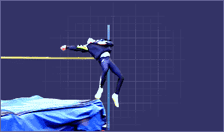
Use your leading leg to twist your body over the bar and aim to lay back. These three things will help you the clear the bar:
1.- Arms to your side.
2.- Arch your back
3.- Lift your hips


B.4.- Landing
Long jump
Landing is a very important part of long jump. If you have the perfect jump but land wrong you have just ruined the whole jump. You should land steady and with your feet as close as they can be together. If you jump with your legs straight out you should land on your bottom. Your jump is measured from the furthest back point so you do not want to put your hand back when you jump. Landing is not complicated, if you get it right it is quite simple.
On landing, bend your knees and move your upper body forward as you hit the sand.
To get a longer jump and prevent yourself from falling backwards, lean to one side as you land, using one elbow for balance. If you land on sand, the sand slides forward and you can touch with your bottom on the sand. However, if you land in a mat, don´t try it. You must only land with your feet at the same time as far as you can.
After landing, remember walking back through the sand pit will get you disqualified in a competition.


High Jump
Even after your bottom has cleared the bar, make sure you lift your head and feet to complete the clearance. Jumping too high too early and overarching your back are common mistakes which lead to knocking the bar off.